
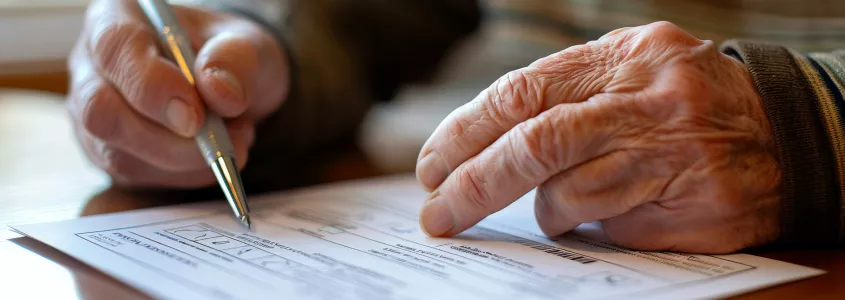
Mere estrangement between a parent and a child is not sufficient grounds for disinheritance; this is what a 2025 Supreme Court ruling decreed. In this article, as expert inheritance lawyers, we explain what disinheritance is, what the grounds for disinheriting are, and what requirements must be met.
What is disinheritance?
Disinheritance occurs when the person making a will deprives a forced heir of the statutory share (legitime) that corresponds to them by law in the estate. For disinheritance to take place, the grounds regulated in the Civil Code must exist, which governs both general grounds and specific grounds for disinheriting children and descendants, parents and ascendants, and the surviving spouse.
Disinheritance must be made in a will, and it must express not only that a person is being disinherited but also the specific grounds for that disinheritance.
What are the grounds for disinheriting?
The grounds for disinheritance are regulated in several articles of the Civil Code and are the following:
- Having been convicted by a final judgment for having attempted against the life, caused injuries, or exerted physical or psychological violence within the family environment against the testator, their spouse, a person bound to them by a similar relationship of affectivity, or any of their descendants or ascendants.
- Having been convicted by a final judgment for crimes against freedom, moral integrity, and sexual freedom and indemnity, when the offended party is the testator, their spouse, a person bound to them by a relationship of affectivity, or any of their descendants or ascendants.
- Having been deprived of parental rights over a minor by a final resolution.
- Having accused the testator of a serious crime if convicted of a false accusation.
- An heir of legal age failing to report the violent death of the testator despite having had knowledge of said death.
- Having threatened, committed fraud, or used violence against the testator to force them to make a will, change it, or revoke a will they had made, or having concealed a subsequent will.
- Failing to provide the necessary care due to a person with a disability by persons entitled to the inheritance.
Regarding specific grounds:
To disinherit children or descendants:
- Having denied maintenance or support (alimony) to the parent or ascendant who disinherits them.
- Having physically mistreated them or seriously insulted them verbally.
To disinherit parents and ascendants, they are the following:
- Having lost parental rights.
- Having denied maintenance or support to children or descendants without legitimate reason.
- One of the parents having attempted against the life of the other.
To disinherit a spouse:
- Having seriously or repeatedly breached marital duties.
- Being involved in any of the grounds that entail the loss of parental rights.
- Having denied maintenance or support to the children or to the other spouse.
- Having attempted against the life of the testator spouse.
Is the lack of a relationship between parents and children grounds for disinheritance?
In general, no; there must be a specific reason and it must be proven. In a case analyzed by the Supreme Court, the disinheritance of a daughter by her father was overturned due to a lack of proof that there had been physical or psychological mistreatment, or due to the mere lack of a relationship between the two.
In this case, a man born in 1937 was married to a woman from whom he separated in 1989 and with whom he had two children. In 2005, he executed a will before a notary public stating that since the date of the judicial separation he had not had a relationship with his children and did not even know their addresses; therefore, he disinherited them based on the grounds regulated in Article 853.2ª of the Civil Code, which establishes physical mistreatment or serious verbal insult as grounds for disinheritance.
The man passed away in 2012, and in 2013, the disinherited daughter sued the woman who had been named heir to her father, requesting a declaration of the non-existence of the grounds for disinheritance alleged by the father.
The Supreme Court recalls that a lack of relationship is not in itself grounds for disinheritance, but rather a series of additional circumstances must occur to understand that grounds for disinheritance exist. In this case, the court ruled in favor of the plaintiff daughter and overturned the declaration of the testator's wife as heir, since it is understood to prejudice the statutory share (legitime).
What requirements must be met for case law to understand psychological mistreatment as grounds for disinheritance?
There are three requirements:
- An active and repeated attitude of contempt toward the testator. Mere estrangement is not enough.
- Psychological or moral damage that can be proven to have existed and to have caused harm to the testator.
- The estrangement must occur solely due to the fault of the disinherited person; if the testator also distances themselves, there are no grounds for disinheritance.
How do you disinherit a child?
To validly disinherit a child, several requirements must be met, which are the following:
- The disinheritance must be included in the will.
- The grounds for disinheritance must be explained so that it can be verified that said grounds are one of those regulated by law.
- The disinherited person must be precisely identified. That is, the will must clearly specify, with data that leaves no room for doubt, who the disinherited person is.
The burden of proof regarding the existence of the grounds for disinheritance rests upon the heirs who benefit from said disinheritance.
In short, these are complex cases in which it is fundamental, if it comes to trial, to prove the existence of the grounds for disinheritance so that the judge can declare the disinheritance null and void.
If you have been disinherited and have doubts about how to act, contact our team of expert inheritance lawyers and we will analyze your case.

 A lawyer in less than 24 hours.
We defend your interests
"Anywhere in Spain"
With our online appointment system you will have immediate advice without the need for face-to-face visits or travel.
One of our lawyers specialized in your area of interest will contact you to formalize an appointment and make your consultation by video call.


Add new comment