
Table of contents
A notarial will is executed before a notary, which guarantees its legality. A holographic will is handwritten by the testator without immediate notarial involvement, while a closed will is delivered sealed to the notary, preserving the secrecy of its contents. The notarial or open will is the most difficult to contest due to the presumption of truthfulness and the assessment of capacity carried out by the public official.
The notarial will: maximum legal certainty
The notarial will, or open will, is the most common model in Spain. In fact, it is the one we all have in mind when we think about making a will: a person goes to a notary and expresses their wishes orally or in writing so that the notary can then draft the document in accordance with current law.
The advantages of a notarial will are clear. Firstly, the notary carries out an assessment of capacity, that is, they attest that you are in full possession of your mental faculties at the time of making the will. In addition, the document is kept in the notarial records, so it cannot be lost or destroyed by interested third parties.
Clearly, it also has some minor drawbacks. The most notable is the lack of complete privacy, as the notary knows the contents. However, they are bound by professional secrecy and cannot disclose it. This is the main difference between an open and a closed will, as we will see below.
The holographic will: autonomy with risks
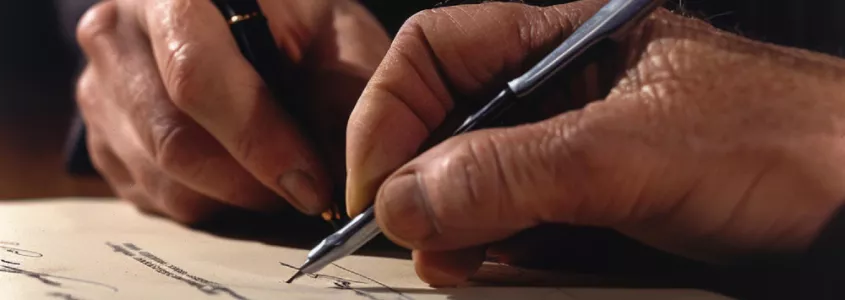
A holographic will is one that you write yourself in your own handwriting on paper. Therefore, it does not require the presence of a notary at the time of its creation, which at first glance may seem appealing due to its simplicity and zero cost.
However, for this type of will to be valid, a number of requirements must be met:
- You must be of legal age (18 years old).
- It must be handwritten, meaning that using a computer is not permitted.
- It must include your signature together with the full date (day, month, and year of drafting).
Any alterations must be validated with your signature. The issue is that, after death, the document does not automatically become valid; instead, the heirs must take it to a notary within a maximum period of five years to carry out probate (verification of the handwriting’s authenticity) and formal registration. If any of them challenge its authenticity, the process becomes more costly, as a handwriting expert must produce a report.
The closed will: absolute secrecy
The third type of will in Spain is the closed will, which could be defined as a hybrid between the notarial and the holographic will. In this case, you may prepare the document either by hand or using a computer. Then, you must place it in an envelope that is sealed in such a way that it cannot be opened without breaking the seal. Finally, you must go to a notary to authorise the execution record on the outside of the envelope.
The main difference between a closed and an open will is that, in the former, no one—not even the notary—will know the contents of the will until after death. At the same time, this is its main drawback. Since the clauses have not been reviewed, there is a risk that they may be invalid for breaching the law—for example, by failing to respect compulsory shares. It should also be noted that if the will appears to have been tampered with or the seal is broken, it automatically becomes null and void.
So, is it more difficult to contest an open or a closed will?
Now that you understand the difference between an open and a closed will, as well as the characteristics of a holographic will, we can answer this question: the notarial or open will is the most difficult to contest.
But why exactly? Mainly because of the role of the notary. When a third party attempts to invalidate a will, they usually claim that the testator lacked mental capacity or that coercion led to defects in consent. However, thanks to the notary’s involvement, there is a presumption of capacity.
To overturn this document in court, the claimant would need compelling medical evidence proving that, on the exact date of signing, the testator was not in control of their actions—something extremely difficult to prove against the notary’s testimony.
By contrast, the holographic will is the most vulnerable. It is relatively easy for a dissatisfied heir to claim that the handwriting is not yours or that you were forced to write it. Moreover, if the document is kept at home, there is a risk that someone who finds it and feels disadvantaged may simply destroy it.
Finally, the closed will has the weakness of its content. As it is not supervised by a legal expert during drafting, it often contains legal errors that make it easier to challenge on the grounds of invalid clauses, unlike the open will, where the notary advises you to ensure that the document strictly complies with the Civil Code.
That said, it is clear that open and closed wills are the two most popular options in Spain, but they do not offer the same level of legal certainty. Therefore, if you want to avoid family disputes after your death and ensure that your assets pass to those you have chosen during your lifetime, the notarial open will is the most robust and effective option.

 A lawyer in less than 24 hours.
We defend your interests
A lawyer in less than 24 hours.
We defend your interests"Anywhere in Spain"
With our online appointment system you will have immediate advice without the need for face-to-face visits or travel.
One of our lawyers specialized in your area of interest will contact you to formalize an appointment and make your consultation by video call.


Add new comment